https://www.youtube.com/watch?v=g8qBhLlDNTg&list=PLaKD1ZIZH2LvFKbwgr9JRtpWg7uHSEC59&index=2 AMCI provides a comprehensive program focused on testing support. Within this program, there is…
Confidence Hacks:
5 Science-Backed Ways to Build Confidence and Overcome Anxiety
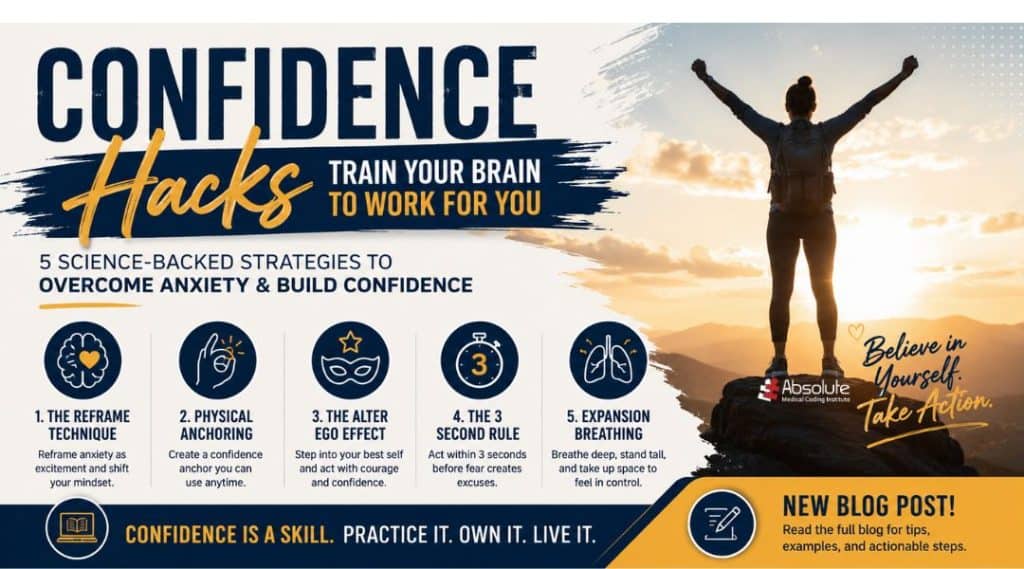
Do you struggle with anxiety before a test, job interview, presentation, or important life event? If so, you’re not alone. Millions of people experience nervousness and self-doubt when facing challenges. The good news is that confidence is not something you’re born with. It is a skill that can be developed and strengthened over time.
If you’re looking for practical ways to build confidence, reduce anxiety, and improve performance under pressure, these five science-backed confidence hacks can help train your brain to work for you instead of against you.
Why Confidence Matters
Confidence affects nearly every area of life, including academics, career advancement, public speaking, relationships, and personal growth. When confidence is low, fear often takes control. When confidence is strong, you’re more likely to take action, embrace opportunities, and achieve your goals.
Learning how to build confidence is one of the most valuable investments you can make in yourself.
1. Reframe Anxiety as Excitement
One of the most effective confidence-building techniques is learning how to reframe anxiety.
The physical symptoms of anxiety, such as a racing heart, sweaty palms, and butterflies in your stomach, are remarkably similar to the symptoms of excitement. Instead of telling yourself, “I’m nervous,” try saying:
“I am excited.”
This simple shift helps your brain reinterpret the situation as an opportunity rather than a threat.
Benefits of Reframing Anxiety:
- Reduces negative self-talk
- Improves performance under pressure
- Increases confidence before tests and presentations
- Helps manage public speaking anxiety
2. Use Physical Anchoring to Trigger Confidence
Physical anchoring is a powerful mental performance technique used by athletes, speakers, and professionals.
Think of a time when you felt confident, successful, and unstoppable. While focusing on that memory, press your thumb and index finger together.
Repeating this process trains your brain to associate that physical action with positive emotions and confidence.
Over time, you can use this “confidence anchor” before stressful situations such as:
- Job interviews
- Certification exams
- Public speaking events
- Networking opportunities
Why It Works:
Your brain naturally connects physical actions with emotional states. Anchoring allows you to intentionally recreate feelings of confidence when you need them most.
3. Create an Alter Ego for Success
Many high achievers use an alter ego to boost confidence and overcome self-doubt.
One famous example is Beyoncé, who created “Sasha Fierce” to help manage stage anxiety and perform confidently in front of large audiences.
An alter ego allows you to temporarily step outside your fears and insecurities by embodying a more confident version of yourself.
Ask yourself:
“How would my most confident self handle this situation?”
Then act accordingly.
Benefits of the Alter Ego Effect:
- Reduces fear of failure
- Improves public speaking confidence
- Encourages courageous decision-making
- Helps overcome imposter syndrome
4. Follow the 3-Second Rule
One of the biggest obstacles to confidence is hesitation.
The longer you wait to act, the more opportunities your brain has to create excuses, fears, and worst-case scenarios.
The solution is simple:
Move Within Three Seconds
If you want to:
- Ask a question
- Speak up during a meeting
- Introduce yourself to someone new
- Apply for a job
- Start a new project
Take action within three seconds.
Action interrupts fear and builds confidence through experience.
Why the 3-Second Rule Works:
Confidence is often the result of action, not the prerequisite for it.
5. Practice Expansion Breathing
Anxiety affects both the mind and body.
When we’re nervous, we often:
- Hunch our shoulders
- Take shallow breaths
- Avoid eye contact
- Make ourselves physically smaller
Expansion breathing helps reverse these stress responses.
How to Practice Expansion Breathing:
- Stand or sit up straight.
- Relax your shoulders.
- Take a slow, deep breath into your abdomen.
- Expand your chest.
- Slowly exhale.
This technique signals safety to your nervous system and helps you feel calmer and more in control.
Benefits:
- Reduces anxiety
- Improves focus
- Promotes relaxation
- Increases feelings of confidence
Final Thoughts: Confidence Is a Skill, Not a Personality Trait
Many people believe confidence is something you either have or don’t have. In reality, confidence is a skill that can be developed through consistent practice.
By using techniques such as reframing anxiety, physical anchoring, creating an alter ego, following the 3-second rule, and practicing expansion breathing, you can train your brain to respond more effectively to challenges and stressful situations.
Remember:
You do not have to eliminate fear to become confident.
You simply need to take action despite it.
The more you practice confidence, the more natural it becomes.
Looking for More Confidence-Building Strategies?
Follow our blog for practical tips on overcoming anxiety, improving mindset, building resilience, and developing the confidence needed to succeed in school, work, and life.